Showing posts with label Legislative Issues and RPAC. Show all posts

Monday, September 1, 2008

Top NYSAR Legislative Priorities Signed Into Law by Governor Paterson


Two of NYSAR's top legislative priorities were signed into law by New York Gov. David Paterson this month, including the Commission Escrow Act and a sex offender ban that precludes all convicted sex offenders from obtaining a real estate license.

The Commission Escrow Act provides that when a contractually agreed upon commission has not been paid, the disputed funds shall be placed into safe keeping from the proceeds of the sale, pending an impartial review and determination.

Gov. Paterson also signed NYSAR-supported legislation that precludes all convicted sex offenders from obtaining a real estate license. Under the parameters of the new law, any convicted sex offender will be barred from holding a real estate license. The measure closes a loophole in previous statute that only precluded felons from obtaining a real estate license. As such, misdemeanor-level sex offenders had been eligible to obtain a real estate license.

This article is from NYSAR's Communication Center E-News dated August 18,2008

NY's Property Tax Cap Legislation Passes State Senate


Property tax cap - Governor Paterson’s property tax cap proposal passed by a vote of 38-to-20 with all negative votes being cast by Democratic senators largely from New York City. Under the plan, school district budgets would be limited to no more than 4-percent growth, or 120 percent of inflation. Critics, including the New York State United Teachers (NYSUT), say the bill is simply a gimmick. NYSUT has launched a costly and aggressive advertising campaign against the plan. The Assembly too has expressed little support for the bill. The most recent statewide poll shows 69 percent of New Yorkers support the property tax cap. Last month, NYSAR issued a press release urging lawmakers to return to Albany to pass the bill.


This article is from a news relesase provided by NYSAR's Governmental Affairs Department dated August 16,2008

Saturday, August 2, 2008

NYSAR President Urges NY Legislators to Return to Albany to Approve Governor's School Tax Cap Proposal


Statement from New York State Association of REALTORS President Linda J. Page

Today, New York’s 62,000 REALTORS call upon their representatives in the state Legislature to return to Albany for the purpose of providing relief to our state’s beleaguered homeowners who are being crushed by high property taxes. We urge them to approve Gov. David Paterson’s school property tax cap proposal as an important first step toward providing New Yorker’s with a decreased tax burden.

The preliminary report from the New York State Commission on Property Tax Relief found that New York State’s local taxes are the highest in America – 79 percent above the national average.

It also found: property tax levies in the Empire State are rising at more than twice the rate of inflation and salary growth; outside of New York City, 62 percent of property taxes are school taxes; and in terms of tax rate, nine of the 10 highest counties in the nation are in upstate New York.

The New York State Association of REALTORS strongly supports the portion of Gov. Paterson’s Program Bill #62 that would cap the growth of school property tax levies at 4 percent or 120 percent of the Consumer Price Index (CPI), whichever is less. This tax cap proposal is a step in the right direction toward solving New York’s property tax crisis. New Yorkers clearly agree. A recent Siena College poll found that 69 percent of voters support of the governor’s property tax cap bill – regardless of political affiliation or geographic location.

In addition to the highest property taxes in the nation, home buyers in New York State are also expected to pay the highest closing costs in the nation. Depending on where a homebuyer lives, as many as four separate state and local taxes may be imposed on the recording of a mortgage. Many of these closing costs are fixed and must be paid by low, moderate, and high income homebuyers alike.

The net result is that these combined taxes make homeownership unattainable for many who aspire to achieve the dream of owning a home. New York is competing with states to lure and retain a young and well-educated workforce, and losing the battle due in large part to the state’s regressive tax structure. According to statewide census data released in March 2007, New York was one of only four states that failed to grow in population since 2005, with 46 of New York’s 62 counties experiencing more people moving out during 2005 than moving in for a total one-year loss of 225,766.

This issue has been thoroughly studied by the bi-partisan, blue-ribbon Commission on Property Tax Relief, which also found the need for a school property tax cap, along with other proposals for stemming the tide of ever-rising property taxes.

Now, it is time for Albany lawmakers to enact structural reforms to the tax system that will foster tax savings to property owners. Every step the state takes toward lower homeownership taxes is a step toward increasing the state’s quality of life and economic vitality.

The school property tax cap proposal will help make homeownership more attainable and appealing by allowing people to afford to stay in New York State. Offering individuals and families the prospect of meaningful tax relief provides a tangible incentive to purchase a home and grow roots in New York, which will certainly pay lasting dividends.

New York’s REALTORS applaud the governor for his leadership on this issue, and urge our legislators to follow his lead.

Friday, June 27, 2008

Lobby Day Proves To Be A Huge Success


On June 10th NYSAR sponsored its annual event knows as Lobby Day. On this day every year, REALTORS® throughout New York State converge upon Albany to meet with their legislators to discuss real estate issues and legislation that benefits, as well as hurts our industry, our clients and customers.

This year over 150 REALTORS® spanning from Long Island to Buffalo had their voices heard in Albany. I also attended on behalf of the Otsego-Delaware Board and met with State Senators Seward and Bonacic and Assemblyman Pete Lopez.

I can’t over-emphasis the importance of Lobby Day because of the unity, strength and focus our members provide on a number of very important issues at that time. Over 150 REALTORS® discussed with their legislators the importance of the Commission Escrow Act (which is pending legislation designed to protect your earned but unpaid commissions), Sex Offender Ban (proposed legislation to ban ALL sex offenders from holding or obtaining a real estate license), a call for decreasing real estate taxes (because citizens of NY have the dubious honor of having the highest tax burden per capita in the nation – more than 200% higher than the national average), First Time Home Buyer Savings Account (which would allow a $5000 per individual or $10,000 per couple tax deductible contribution toward the purchase of a first home). These were some of the many issues discussed by concerned REALTORs® on June 10th.

Since Lobby Day, more than half of the members in the Assembly have signed on to the Commission Escrow Act bill which brings the total number of sponsors in that house to 81, our strongest backing yet. On June 11th, the bill moved from the Assembly Judiciary Committee to the Codes Committee. This is very good news and so far this bill has not been stalled in committee.

Concerning the Sex Offender Ban, support increased for this legislation when nearly 500 e-mails from REALTORS® were sent to lawmakers leading up to Lobby Day showing our support for this important bill. These emails were in response to a “Call for Action” NYSAR sent to members. This legislation has since moved from the Assembly Judiciary Committee to the Codes Committee by an overwhelming vote of 19 in favor to 2 opposed. This is a huge victory because the bill has remained stalled in the Judiciary Committee since 2006.

Because of the current housing market and economy, momentum is gaining in Albany for substantive measures to be taken concerning school taxes and property taxes in NY State. With the participation of our members at Lobby Day, there was a clear signal sent to our representatives that REALTORS®, are fed up with ever increasing taxes which only hurt our state’s economic future and our real estate industry.

In prior years I’ve discussed taxes with our area legislators and received only vague assurances of their mutual concerns on this issue. Now, in 2008, there seems to be very widespread support for doing something real to reduce our tax burdens in this state. NYSAR has been faithful for years in trying to get our legislators to deal with soaring taxes. Because of our persistence, as well as the state of our economy, our concerns about high taxes are now being taken very seriously. Please read the article written by The Legislative Gazette dated Monday June 23rd, posted on the blog (http://www.odbr.blogspot.com/) titled “Governor Holds Legislators Feet to Fire Concerning Taxes” for more information about current legislative tax reducing proposals being made in Albany.

During Lobby Day, NYSAR’s President Linda Page had a chance to meet with Jim Tedisco, the highest ranking minority member of the Assembly to discuss the issues that are important to us. Linda also met with Secretary of State Lorraine Cortez-Vazquez who is in charge of the Department of State. As you can tell, events like Lobby Day help us meet with government leaders to get business done.

Every REALTOR® member should do whatever he or she can to help all of us to get things done in Albany. Your help in NYSAR's efforts to secure legislation designed to protect and help our customers and clients is vital . Your RPAC support as well as financial contributions are the reason we are having the successes we are having. Without your financial and moral backing our voice wouldn’t be heard. That’s why your assistance (in terms of financial contributions, response to NYSAR’s “Call to Action” and participation on Lobby Day) is so important. Thanks you for the support you have already given to RPAC and also to me and your RPAC Chairperson to keep you informed of the issues and to go to Albany on your behalf.

Saturday, June 21, 2008

NYSAR's Latest Legislative Efforts in Albany Gain Ground


As the 2007-08 legislative session winds-down, the following action on real estate related legislation occurred in Albany:

Commission Escrow Act (A.7519 Gianaris/S.4874 Volker)

Legislative support to strengthen the laws that protect earned but unpaid commissions continues to grow. More than half of the members of the Assembly have signed on to the bill including the latest addition, Janele Hyer-Spencer (D-Staten Island), which brings the total number of sponsors in that house to 81, our strongest backing to date. Following our consistent advocacy effort including member participation in online “Calls for Action," the bill was reported from the Assembly Judiciary Committee against the wishes of the chair by a vote of 19 in favor to 2 opposed. The bill is now in the Codes Committee. NYSAR will continue working with the bill’s sponsor, Assemblyman Michael Gianaris, to keep the momentum going toward reporting this bill to the floor of the Assembly.

In addition, NYSAR staff met with counsel for the New York State Consumer Protection Board this past week. It was a productive meeting in which NYSAR staff and counsel were able to address each of the concerns that were raised by the CPB. We were also able to clarify several points for the CPB as well as provide further information on how the act would work in practical terms. NYSAR concluded the meeting by reassuring them that our doors are always open and that we would be happy to answer any further questions they may have regarding our Commission Escrow legislation.

Sex Offender Ban (A.1269 Bing/S.1531Fuschillo)

REALTOR support of the legislative proposal to ban all sex offenders from holding or obtaining a real estate licensee was bolstered when nearly 500 e-mails supporting the bill were sent to lawmakers leading up to Lobby Day. The e-mails were in response to a NYSAR online “Call for Action,” which clearly resonated with lawmakers as the piece of legislation was ultimately moved from the Assembly Judiciary Committee to the Codes Committee by an overwhelming vote of 19 in favor to 2 opposed. This was a huge victory as the bill has remained stalled in the Judiciary Committee since 2006. Protecting the safety of their customers and clients is a top priority for members of the New York State Association of REALTORS. NYSAR will continue its efforts with Assemblyman Jonathan Bing in support of this measure with the ultimate hope of bringing it to the floor of the Assembly for a vote by the entire body.

Agriculture District Boundary Disclosure

NYSAR staff continues to work with Assemblyman David Koon (D-Perinton) and Senator George Winner (R/I/C-Elmira) to amend NYSAR-opposed legislation to extend the agriculture district notice to buyers or real property located within 500 feet of the boundary of an agricultural district. Current law requires notice just to those to properties either partially or directly located within an agriculture district.


Leaders reach agreement on foreclosure relief

Gov. David Paterson and leaders of the state Legislature announced an agreement this past week to revamp the state’s foreclosure laws. Under the agreement, lenders would have to give homeowners at least 90-days warning prior to initiating foreclosure proceedings, and they would be required to provide homeowners a list of local state-approved housing counselors. Additionally, lenders must make a “reasonable and good-faith” effort to determine whether an applicant can repay a loan and must meet with borrowers if they were to default and were facing foreclosure. The bill also includes new consumer protections that would require loan brokers to act in the borrower’s interest and present loans that are best suited to the borrower’s financial situation.
This article is taken from NYSAR's Governmental Affairs Update for 6/20/08

Thursday, June 12, 2008

REALTORS® Join Congress in Urging Reform of U.S. Health Care System


According to an article written by NAR dated 6/10/08- The National Association of Realtors® joined a bipartisan group of members of Congress today as the U.S. House of Representatives introduced legislation designed to make insurance more available and affordable for the 47 million employees of the nation’s 5.8 million small businesses and more than 14 million self-employed individuals. In announcing its support for the Small Business Health Options Program (SHOP), NAR reiterated the importance of reforming the U.S. health care market for small businesses and independent contractors.

In a recently conducted 2008 NAR Health Insurance Coverage survey, 82 percent of Realtors® believed the current health care system is not meeting the needs of most Americans, and nine out of 10 Realtors® thought that the U.S. health care system should be reformed. Nearly a quarter of NAR’s 1.2 million members do not have health care insurance, and for most Realtors® without insurance, the reason is cost.

“More than half of all Realtors® report that the current health care system is not meeting their needs or those of their family,” said NAR Treasurer James L. Helsel, Jr., who spoke at today’s press conference. “NAR joins with these members of Congress today because this issue is substantial and meaningful, and it affects Realtors® and other small business employees and independent contractors all across our country every day.”

As proposed, SHOP would offer tax incentives to encourage states to reform small group insurance markets and to make health insurance premiums more affordable for small businesses and the self-employed. It would also develop a nationwide insurance small-business purchasing pool that would still be subject to state insurance regulation to protect those who choose to participate. The House bill is a companion to the SHOP legislation introduced by the Senate in April.

“We believe that the legislation introduced today is a big step forward in addressing the challenges facing our members, and we thank Congressmen Ron Kind, D-Wisc.; Phil English, R-Penn.; John Barrow, D-Ga.; C.W. Bill Young, R-Fla. and other distinguished members for their leadership,” Helsel said. “We appreciate that Congress recognizes that small businesses need help navigating health insurance markets and have created a role for trade associations to help guide their self-employed and small business members through the process.”

NAR supports the House-introduced SHOP concept and believes that the proposed program will offer more choices and lower costs for the self-employed and small businesses.

US lawmaker targets Housing Rescue Bill by July 4


According to a recent article on NYSAR - A bill to prevent thousands of homeowners from foreclosure is still on schedule to proceed to President Bush for signature prior to July 4.

While Senate Banking Committee Chairman Christopher Dodd and other legislators have stated for weeks that they want to reach a compromise on a final bill and send it to Bush by that date, the full Senate still has not voted on legislation approved by Dodd's committee in May. The House also sanctioned its own bill in May.

As composed, the Senate version would establish a new, $300 billion federal mortgage insurance fund that could protect a half-million borrowers from foreclosure. Lenders would have to forgive part of the initial loan amount to take part. In addition, the legislation would create a stricter regulator for mortgage-finance agencies Fannie Mae and Freddie Mac.

Congress is attempting to stop a slew of foreclosures predicted to impact 1.4 million households in 2008 as home values decline and mortgage borrowers fail to meet payment obligations. Although the House bill is similar to the Senate's, how to bankroll the insurance fund remains a point of contention.

Reuters (06/09/08) Drawbaugh, Kevin

New York State Commission on Property Tax Relief Makes It's Much Anticipated Report


By MARIA BRANDECKER
Legislative Gazette Staff Writer
Mon, Jun 9, 2008

After an initial delay, the New York State Commission on Property Tax Relief released its highly anticipated report June 2, with recommendations it said should save taxpayers money and address the causes of high property taxes by reforming policies for new and existing mandates.
The report included three main suggestions: adopt a property tax cap, institute a “circuit breaker” and reform state mandates on local governments and schools through legislation.
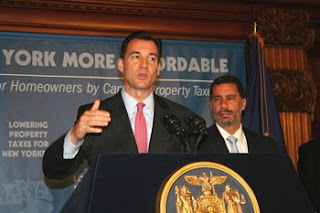
The commission was created by former Gov. Eliot Spitzer who appointed Nassau County Executive Thomas Suozzi as chair. The commission was given the task of examining unfunded state mandates, the causes of high property taxes, the impact of increased state aid and existing property tax relief programs, and the effectiveness of property tax caps in other states and potentially in New York.
In addition, the commission was given the task of finding an effective way to impose a limit on school property tax growth without impacting the ability of a school district to provide a quality education.
Since February, the six commission members heard testimony from taxpayers, school board members, school superintendents, elected officials, business leaders, representatives of teachers’ unions and policy experts on how to lower property taxes.
Suozzi said there are only three ways to address rising education costs: decrease expenditures, increase state aid to school districts or continue to increase property taxes.
According to the commission’s report, New York spends more per student on primary and secondary education then any other state. The report shows that in the 2008-2009 school year, the state will spend an estimated $18,768 per student, outside of New York City, Buffalo, Rochester, Syracuse and Yonkers.
In addition, the annual growth rate of school expenses increased from 4 percent to 6 percent and is estimated to be as high as 7 percent in the 2007-2008 fiscal year.
The primary sources of school funding are local property taxes and state funding. According to the report, New York’s percentage share of school funding is below average. In 2005-2006, 53 percent of school funding, excluding New York City, came from local revenue, 43 percent came from state funding and 4 percent came from federal aid. The commission found that the state’s share of school funding over time from records reaching back to the 1940s consistently tracked lower than the national average.
However, the report also concluded that the state’s contribution in dollars to school funding is relatively high. Since the state is spending more money per student, the burden is falling onto local and state taxpayers. The report also indicated that the state’s funding until 2007 had not kept up with increasing expenses.
In order to address these issues, the commission suggested the Legislature implement a school property tax levy cap. A cap would limit the amount by which the total property tax levy can increase from year to year. The commission recommended setting the cap at 4 percent or 120 percent of the consumer price index, whichever is lower.
If the maximum tax levy increase permitted under the cap is not used in a year, the unused portion could be “banked” and used another year to increase the levy up to 1 ½ percent above the 4 percent cap.
The commission suggests that school districts would no longer have to submit their budgets to the voters in years when the tax levy growth does not exceed the cap. If growth does exceed the capped amount, it would be subject to voter approval. As a result, the current school budget voting process would be replaced by a cap override vote.
The votes required to override the cap would be based on state aid growth by district. If the annual growth for a district is at least 5 percent in the current year the vote needed to override the levy cap would be 60 percent. If the annual growth is less than 5 percent, a 55 percent vote would be needed to override the cap.
Under the commission’s recommendation, taxpayers could vote to “underride” the increase and keep the levy growth to a level beneath the cap.
Suozzi said after a cap is adopted, the commission recommends a “STAR circuit breaker.” A “circuit breaker” would provide relief to individuals by limiting the percentage of household income that could be spent on property taxes annually.
The Basic STAR, Enhanced STAR and Middle Class STAR are programs that provide homeowners property tax exemptions supplemented by state funding. The commission found several fundamental problems with the various STAR programs but suggested the benefits most taxpayers receive from the programs should remain and at least $2 billion of the existing STAR program should be transitioned to income based relief, which the circuit breaker would provide.
The commission said there should be a careful review of all existing individual property tax exemptions to see whether they still make sense and are fair. The report stated if any changes are to occur they should not sacrifice the benefits of the middle class taxpayers because they need it the most.
Based on the commission’s recommendations, the circuit breaker would be limited to the primary residence of individuals, eligibility would be phased out for those with higher income and property values and benefits would be income based. Any excess amount paid by a household would be partially reimbursed by the state. However, the reimbursements could be only a portion of what was overpaid to ensure people living on expensive properties are paying their share.
Sen. Elizabeth Little, R,C,I-Queensbury, and Assemblywoman Sandy Galef, D-Ossining, have already introduced legislation (S.1053a/A.1575a) that is similar to the circuit breaker recommendation.
Also suggested by the commission is altering new and existing mandates and a call for no new legislative mandates and no new regulatory mandates from the state Education Department without a complete accounting for the fiscal impact on local governments, which must include full documentation, local government input and proposed revenue sources to fund new mandates.
In addition, the commission recommends an annual report be conducted by the state comptroller’s office explaining the cumulative cost to localities complying with all new regulatory and legislative mandates. According to the commission, this would help increase accountability.
The commission also recommends amending the Triborough provision of the Taylor Law to prevent teachers who are working under expired contracts from receiving salary and benefit increases until new contracts are negotiated.
The Taylor Law regulates union negotiations between public employee unions and public employers in the state. The law contains the Triborough amendment which makes it an improper practice for a public employer to “refuse to continue all the terms of an expired agreement until a new agreement is negotiated.”
The commission suggests that a single unit at the state Education Department be responsible for all existing school district reporting. The unit would be responsible for streamlining and consolidating all reporting. The report states because of overlapping state and federal requirements, school districts must prepare numerous and sometimes redundant reports.
Before the commission releases its final report in December, it suggests that a tax relief task force on mandates undertake a review of existing school district mandates. This process would involve collaboration among representatives of school districts, state Education Department and lawmakers.
The commission recommends temporarily suspending school building aid for new projects in districts identified for potential reorganization. This would prevent new building projects from being launched during a period consolidation is being contemplated and would end when the decision on consolidation has been made. The districts would be identified either by a Boards of Cooperative Educational Services school district restructuring committee or by the commissioner of education.
The commission also suggests repealing the Wicks Law or dramatically increasing its monetary threshold. Schools and municipalities have long complained Wicks Law requires multiple contractors for capital projects which increases their costs substantially. Legislation was introduced this session to increase the threshold for Wicks Law.
The commission also suggests consolidating non-instructional and purchasing services through BOCES. This would encourage the use of BOCES for back office school district operations such as payroll and purchasing. Using BOCES back-office services could be a cost effective way for school districts to perform operational, management and other non-educational functions.
In addition, each BOCES region should create a committee to evaluate potential restructuring opportunities including consolidation of districts.
The commission recommends consolidating property assessment and property collection at the county level. This would eliminate tax shifts resulting from changing equalization rates within the county, improvement in assessment accuracy resulting from more regionalized data analyses and market monitoring and specialization of staff for specific types of properties.
The commission recommends that school districts be required to report on union negotiation outcomes to the governor’s office of employee relations. These outcomes would be summarized by the governor’s office in an annual report to the governor and Legislature.
In addition, the commission recommends that school districts be required to report on collective bargaining outcomes in their annual school budget presentations to the voters in a manner that clearly and transparently informs the public of those outcomes and attendant costs.
This article along with others like it on the subject of New York State Government can be found at http://www.legislativegazette.com.

Wednesday, June 11, 2008

States Move to Cut Property Taxes


This article is taken from REALTOR® Magazine Online Edition Daily News dated 6-11-08:

Even with declining home sales and rising foreclosures shrinking local tax bases, a number of state governments are either capping or cutting property-tax rates.

Since the first of the year, Indiana and Florida have passed new property-tax curbs, while New York looks to be the next state to roll back property taxes.

However, officials warn that many of these property-tax initiatives are likely to lead to increases in other kinds of taxes--such as "swaps," under which property taxes are slashed and made up for by levies elsewhere.

In Florida, for example, the state may soon tap "snowbirds"--retirees who live in the state only part of the year -- to make up for lost revenues.

Source: The Wall Street Journal, Martin A. Vaughan (06/11/08)

NAR Testifies in Support of Homebuyer Tax Credit


The House Small Business Committee held a hearing on June 5 to review the impact of the housing crisis on small businesses and to discuss tax incentives that might help stabilize housing. NAR Treasurer Jim Helsel presented testimony urging that Congress act quickly to move to conference and send a final version of tax credit legislation to the President for his signature. In his comments, Mr. Helsel emphasized the importance of making the credit available for the purchase of any type of residential property that would be used as a principal residence. (The Senate version of H.R. 3221 allows the credit only for the purchase of foreclosed property.) In addition, he recommended that Congress raise the income limits the House imposes, particularly for those who file single returns.

The testimony also explored the importance of the so-called "small" individual investor and explained the importance of adjusting the exceptions to the passive loss rules so that more small investors will return to the market. The limits for the exception have not been adjusted since their original enactment in 1986.

This article is from NAR's -The Washington Report dated 6/9/08

Wednesday, May 21, 2008

NAR's Midyear Meeting in Washington Yields Success and Pushes for Progress


Midyear Meetings Showcase REALTOR Party Influence on Capitol Hill
Nearly 10,000 Attendees Press Congress for Swift Action on Housing Legislation Amendment


REALTORS from across the nation recently converged on Washington, DC to exercise the most fundamental right granted by the Constitution: "the right of the people peaceably to assemble, and to petition the Government for a redress of grievances."


Nearly 10,000 REALTORS exercised their rights on behalf of all 1.2 million members of NAR and over 75 million homeowners. Elements of the 2008 NAR Federal Legislative Advocacy Agenda aren't grievances in the traditional definition of the word, but they are requests to address issues of critical importance for the future of our industry.


REALTORS meet with Congressional leadership


REALTORS pressed the case for additional housing stimulus measures to the Congressional leaders of both political parties by meeting with Speaker of the House Nancy Pelosi (D-Calif.) and Minority Leader John Boehner (R-Ohio). In addition, REALTORS briefed Senate Majority Leader Harry Reid (D-NV) and Senate Minority Leader Mitch McConnell (R-KY) on the state of real estate markets around the country and the need to act on the measures already passed by the House of Representatives.


REALTORS and Congress Working Together


Working with our REALTOR Party congressional allies, NAR successfully included a housing component into the administration's Economic Stimulus Package. These measures, including increased FHA loan limits and increased Conforming Loan Limits for Freddie Mac and Fannie Mae, have helped many American families avoid foreclosure, refinance mortgages and bring increased stability to the market. Unfortunately these increases will expire December 31, 2008 unless Congress enacts permanent increases. The primary mission of REALTORS visiting Members of Congress and Senators was to stress the importance of enacting a Housing Stimulus Package.


The three elements of the package are:

1. FHA Reform legislation that would make FHA a more flexible and widely-utilized program for borrowers and lenders alike and makes higher loan limits permanent.


2. GSE Reform legislation that preserves the housing mission of Fannie Mae, Freddie Mac and the Federal Home Loan Bank system and makes higher loan limits permanent.


3. Homebuyer Tax Credit that would be widely available for prospective homebuyers. Assure that the credit is available for any property purchased as a principal residence.


Moving legislation through Congress is a challenging task, but we have achieved significant progress on the Housing Stimulus Package and will continue to press Congress to get the legislation to the President's desk for signature into law.


Other goals NAR is working to achieve, involve improving access to affordable insurance through a reauthorization of the National Flood Insurance Program (NFIP) and Property and Casualty Insurance legislation that enhances the availability and affordability of homeowners' insurance.


As REALTORS kicked off the Midyear meetings, word came from Capitol Hill that the United States Senate had passed a bill reauthorizing the National Flood Insurance Program (NFIP) for 5 years. Once the House and Senate reconcile the differences in their versions of the bill, President Bush can sign it into law.


With more than twenty-eight percent of all REALTORS uninsured, enacting a Small Business Health Insurance Program to make insurance more widely available and more affordable remains an important priority for NAR. For the past fifteen months NAR has been leading a bipartisan effort to develop legislation that could break the deadlock that has stalled past efforts to facilitate access to health benefits for small-business owners, their employees and the self-employed.


The culmination of that effort is a bill introduced by Senate Majority Whip Dick Durbin (D-Ill.) along with Senators Olympia Snow (R-Maine), Blanche Lincoln (D-Ark.), Amy Klobuchar (D-Minn.) and Norm Coleman (R-Minn.) S.2795, The Small Business Health Act Options Program Act of 2008 (SHOP). A companion bill, H.R. 5918, has been introduced in the House of Representatives by Congressman John Barrow (D-Georgia-12). Determining the fate of major legislation, especially during an election year, is an inexact science, but this legislation is a reminder to Congress that NAR will continue to make health care a top priority.


These success stories are made possible by the commitment of REALTORS throughout the nation. We still have a lot to accomplish before the end of this Congress. We also have to stand ready to defend against potential attacks on the favorable real estate policies currently in place. All together NAR, our state and local association partners and members have a route toward continued success and the resources and resolve necessary to get there.


-The Washington Report from NAR

Sunday, May 18, 2008

NAR Members & Our Concerns Were Heard by Congress Last Week


WASHINGTON — It’s not enough for House and Senate lawmakers to pass legislation that will help bring health back to the housing industry; they have to fashion bills that can go the distance and get President Bush’s signature.

Thousands of REALTORS® at the 2008 NAR Midyear Legislative Meetings & Trade Expo are spreading that message this week in the halls of Congress.

The May meetings — REALTORS®' chance to trek to Capitol Hill each year and meet with their legislators — are coming this year at an opportune time.

The House last week passed sweeping foreclosure prevention legislation that includes NAR-backed reforms to FHA and the secondary mortgage market companies Fannie Mae and Freddie Mac.

The House bill also creates a tax credit for home buyers and would make permanent the FHA and conforming loan limit hikes authorized earlier this year as part of an economic stimulus package.

But the bill also includes a controversial plan to let FHA insure replacement financing for buyers after their troubled mortgage has been written down to 85 percent of the current appraised home value.

FHA Commissioner Brian Montgomery has characterized that plan as a “federalization” of the mortgage market and the White House has threatened a veto.

What About the Buyer Tax Credit?

The provision threatens to derail not only the long-sought reforms to FHA and the secondary mortgage market companies, but also holds hostage the homebuyer tax credit. If considered by itself, the tax credit would pass the House and the Senate overwhelmingly and would probably be signed by the president, said NAR tax analyst Linda Goold, speaking at a federal issues update Wednesday.

The House version of the credit, for $7,500, is for first-time buyers and could be taken for the purchase of any home as long as it’s the buyer’s primary residence. The Senate version is for $7,000 and would be for any buyer but it’s limited to foreclosed homes. NAR prefers the House version.

Update Flood Insurance Program

Also on REALTORS®' agenda: flood insurance and small-business health plans.Reauthorization of the national flood insurance program is probably the fastest-moving NAR issue in Congress.

The Senate this week passed a five-year reauthorization in a bill that also provides money for the Federal Emergency Management Agency to update flood mapping. It also forgives almost $18 billion in debt that FEMA incurred after Hurricane Katrina and other disasters. President Bush would probably sign that bill.

However, the House version would add wind damage to the program, something the Senate and the president oppose. Even so, the bill is likely to be passed in some form in the next few weeks because Congress is determined to act before the hurricane season begins in June, said NAR analyst Mark Washko at the forum.

Keep Moving on Health Insurance Bill

Just out of the starting gate is a new attempt at small business health insurance legislation, and the early signs are encouraging. Drafted over the last 15 months with close help from NAR, the Small Business Health Options Program (S. 2795), was designed specifically to address concerns that derailed NAR-backed health insurance legislation two years ago.

Like the previous legislation, the bill would encourage states to reform state purchasing pools and would give a role to associations to help members band together to shop for affordable coverage.

But in a change, it wouldn’t prescribe the minimum benefits that plans must cover, and it would be overseen by state regulators, though with some federal involvement through the U.S. Department of Health and Human Services.

Key interest groups representing small businesses, insurance commissioners, and some insurance providers have either come on board or had positive words for the bill, signaling that it could be effective at getting the health insurance ball rolling again.
A House companion bill, H.R. 5918, was introduced shortly after the Senate bill. “We have a tall order ahead of us,” NAR Chief Lobbyist Jerry Giovaniello, said candidly at the forum.

But thanks to NAR’s bipartisan approach to all of its issues, he added, lawmakers should welcome REALTORS®’ visits this week.

— By Robert Freedman for REALTOR® magazine online

Veto of Foreclosure Bill Not a Certainty


REALTOR® Magazine Online Edition Daily Real Estate News May 16, 2008

Veto of Foreclosure Bill Not a Certainty The House-passed bill to address the housing crisis through targeted FHA intervention and other NAR-backed provisions isn’t dead in the Senate just because President Bush has threatened to veto it.

That's the message from House Financial Services Committee Chairman Barney Frank (D-Mass.), who spoke to REALTORS® at NAR's 2008 Midyear Legislative Meetings & Trade Expo on Thursday.“It’s still an open question whether President Bush will veto the bill,” said Frank, who praised REALTORS® for their highly effective grassroots activism in working for this and other measures.

Frank’s optimism about prospects for his bill, the American Housing Rescue and Foreclosure Prevention Act (H. R. 3221), stems in part from his ongoing conversations with key Senate lawmakers and U.S. Department of Treasury Secretary Henry Paulson, he said.

The bill includes reforms to FHA as well as oversight reforms of the secondary mortgage market companies Fannie Mae and Freddie Mac. Both were provisions sought by the Bush administration. The bill also includes a $7,500 tax credit for first-time home buyers.

The administration’s main objection to the bill is a provision that would allow FHA to insure replacement financing for troubled borrowers.

The bill would encourage lenders to write down a borrower’s existing mortgage to 85 percent of the appraised value of the home in exchange for government-backed insurance on the replacement loan.

The program is expected to help an estimated 500,000 borrowers, at a cost of about $4,800 per borrower. “That’s a small price to pay to avoid all the problems associated with foreclosure,” said Frank.

The Bush administration’s approach to foreclosure prevention, which includes an initiative called FHASecure, is ineffective without any incentive for lenders to make significant write-downs on troubled mortgages, he said.

Frank said he’s willing to see the bill broken up and passed in pieces if that’s what it takes, as each individual provision is critical.

One of the key pieces would make the higher FHA and conforming loan limits passed earlier this year permanent. To let those limits, which now stand at $720,750, go back down at the end of 2008 would be “very disruptive” to the housing market, Frank said. Before their increase, the limit was fixed at $417,000.

— By Robert Freedman for REALTOR® magazine online

NYSAR President Page Calls for Increase in Conforming Loan Limit

NYSAR joined with a coalition of REALTOR associations from across the nation to call upon Congress today to assist the recovery of the housing market by permanently increasing the conforming loan limit to $729,750.

NYSAR President Linda J. Page wrote today to the members of the Senate Banking, Housing and Urban Affairs Committee urging their support of the inclusion of this language in “The Federal Housing Finance Regulatory Reform Act of 2008.” In the letter, she noted the change would not only provide a positive boost to the housing market, but also to the state's economy.


The following is the text of the letter:

Dear Senate Banking, Housing and Urban Affairs Committee:

The New York State Association of REALTORS urges your support for inclusion of language in “The Federal Housing Finance Regulatory Reform Act of 2008” that will permanently increase the conforming loan limit to $729,750. Congress currently has a unique opportunity to give an immediate boost to the economy, bring greater liquidity to a distressed housing market, create new homeownership opportunities, and save hundreds of thousands of homeowners from foreclosure without any additional costs to taxpayers.

With steep declines in housing sales, production, and prices, New York’s slumping real estate sector has staggered the state’s economy. New York’s REALTORS believe increasing the conforming loan limit will supply an immediate infusion of capital into both the housing market and the economy as a whole. The National Association of REALTORS estimates that by increasing the conforming loan limit Congress can generate nearly $42 billion in economic activity through increased home prices alone.

A primary reason for the current decline is New York’s housing affordability crisis that has been exacerbated by the shortage of liquidity in the secondary market for jumbo loans. The shortage of capital for jumbo loans means that New York homeowners who were dragged down by the current market conditions are faced with no safe and affordable refinancing options due to New York’s high-housing costs. A significant number of New York homeowners and homebuyers lack access to not only Fannie Mae or Freddie Mac (GSE) financing, but FHA loans or the VA loan program, both of which must be increased by Congress.

Now, more than ever, Congress can no longer wait to take action. New York’s economy, homeowners and housing market need relief now and the state’s economy, like the nation’s, needs a boost. We strongly urge that the Senate include language in “The Federal Housing Finance Regulatory Reform Act of 2008” that includes an increase in the conforming loan limit to $729,750.

Sincerely,

Linda J. Page
2008 NYSAR President

State News


Lawmakers consider options to address mortgage crisis


As foreclosures continue to rise throughout the state, lawmakers are taking a hard look at how they might provide solutions to the mortgage crisis. The Assembly passed legislation to impose a one-year moratorium on foreclosures. The Senate, however, does not back the Assembly plan and may offer more support to Gov. David Paterson’s program bill (A.10817/S.8143). The governor’s bill would require lenders to send notice to borrowers 60 days before beginning foreclosure, mandate lender and homeowner meet to attempt a settlement, establish a “reasonable ability to repay” standard for home loans, require registration of mortgage loan services and would strengthen the state’s anti-predatory lending law. The bill was the subject of a Senate Banking Committee hearing this past week where it received mostly positive reviews. The Banking and Mortgage Broker industries however oppose the measure and warned lawmakers to be aware of unintended consequences of the governor’s plan including the potential of banks becoming wary of lending in New York and extending the foreclosure process in New York, already the nation’s longest.

State Property Tax Commission to put forth recommendations


The seven-member State Commission on Property Taxes is expected to release its final report by next Thursday recommending ways to alleviate the state’s crushing property tax burden. Expected recommendations include capping school district property taxes increases at a rate of growth between 3 and 4 percentage points, and giving voters the power to override a ceiling. In addition, the commission is expected to recommend that state lawmakers distribute tax relief in the form of a “circuit breaker,” which would provide grants to homeowners when their taxes consume a certain percentage of their income. The report is certain to face resistance from lawmakers and powerful unions including the NYS United Teachers who stand opposed to a tax


Federal News


Cuomo successfully puts forth contentious appraiser code of conduct plan


In an effort to end inflated home values, New York State Attorney General Andrew Cuomo has successfully pushed a sweeping “home valuation code of conduct” that will apply nationally. The code, scheduled to go into effect January 1, forbids mortgage brokers from selecting or paying appraisers; prevents lenders from using appraisers they employ; and prohibits lenders from using appraisal management companies they own or control. Cuomo’s measure applies only to loans funded by Fannie Mae and Freddie Mac, which now account for about 80 percent of new mortgages according to an Associated Press report. The American Bankers and Mortgage Bankers associations oppose the plan. Some appraisers fear prohibiting mortgage brokers from hiring appraisers will lead lenders to route all appraisals through large firms to the detriment of smaller businesses. NAR has expressed concerns with the implementation of the newly created code of conduct and submitted comments to the regulator of Fannie Mae and Freddie Mac, the Office of


Federal Housing Enterprise Oversight (OFHEO).

Senate approves measure to extend national flood insuranceThe U.S. Senate passed legislation to extend the National Flood Insurance Program (NFIP) until 2013 and forgive its $17.5 billion debt from the 2005 hurricane season. The Flood Insurance and Modernization Act of 2008 establishes a commission to examine how to best manage catastrophic risks and an ombudsman within the Federal Emergency Management Agency to ensure the 93 participation insurers in the flood program pay for wind claims. The House bill however includes wind coverage for NFIP participants as an add-on. House and Senate leaders must reach a consensus or the NFIP will expire on September 30.

Saturday, May 17, 2008

Senate Now to Wrestle With Home-Loan Package Recently Passed By the House


REALTOR® MAGAZINE Daily Real Estate News May 12, 2008


It is now the U.S. Senate's turn to craft its own version of homeowner rescue legislation, following the U.S. House of Representatives' approval last week of a home-loan package aimed at easing the foreclosure crisis.

The White House has released a statement threatening to veto any bill that "would force the FHA and taxpayers to take on excessive risk, and jeopardize FHA's solvency." The Bush administration says it's worried that lenders would seek to use the new law to transfer their highest-risk loans to the federal government.

Meanwhile, Pew Center on the States research shows that American homeowners are falling into foreclosure at a rate of 7,000 to 8,000 per day.


Source: Christian Science Monitor (05/12/08)

Legislative Update from Albany


Commission Protection Act Update


This past week, Assemblywoman Ellen Young (D-Queens) and Assemblywoman Michelle Schimel (D-Great Neck) joined as co-sponsors of the NYSAR-supported Commission Escrow Act. This brings us to 78 sponsors of the bill in the Assembly where the bill remains stalled.


NYSAR Government Affairs staff and the NYSAR Commission Escrow contact team members are currently meeting with members of the Assembly Judiciary and Codes committees to urge support of the bill in the respective committees. For more information on Commission Escrow, please visit http://www.stopcommissionsripoffs.com/


Senate to Host Public Hearing on Governor’s Homeowner Protection Bill


The Senate Banks Committee will conduct a public hearing to review Governor Paterson’s homeowner protection bill designed to address mortgage foreclosures and subprime lending practices. The hearing is scheduled for Monday, May 12, at 10 a.m. in hearing room A of the Legislative Office Building. The Governor’s Program Bill would mandate communication between lender and borrower to prevent foreclosures, and enhance the protections of New York’s Anti-Predatory Lending Law, which shields New York borrowers form unscrupulous lenders.

Saturday, May 10, 2008

FHA Mortgage Refinance Bill Moves Ahead


REALTOR® Magazine Online Edition -Daily Real Estate News May 2, 2008


The U.S. House Financial Services Committee on Thursday passed a bill that paves the way for the Federal Housing Administration to refinance $300 billion in troubled mortgages.Lenders would have to erase a portion of the original loan in order to secure a government guarantee on future payments.The plan would "put liquidity back in the market and not interfere with the market, I think, but help restore (it)," Committee Chairman Barney Frank says.Democrats, who hold the majority in the House, are expected to pass the measure once it is presented for a vote next week. A Senate panel is to begin drafting a companion measure on Tuesday.


The bill will probably have a harder time in the Republican-dominated Senate.


Source: Reuters News, Patrick Rucker (05/02/2008)

Friday, May 9, 2008

Legislative Efforts & Agenda At the State Capitol


This is an update of new and pending legislation in Albany.


New York Subprime Predatory Lending Prevention Act (A.10679/S.6394)

Assemblyman Brennan (D-Brooklyn) introduced comprehensive legislation known as the New York Subprime Predatory Lending Prevention Act. The bill imposes numerous consumer protections relating to the issuance of subprime home loans. Some specific provisions include: prohibiting the granting of subprime loans without regard to the borrowers’ repayment ability; holding lenders responsible for policing their associated appraisers; prohibiting originators from influencing the appraisal process; and requiring the legend on subprime lending documents to explicitly state "This loan is a subprime home loan and is subject to the New York Subprime Predatory Prevention Act." The legislation is also sponsored by Senator Klein (D-Bronx).


First Time Homebuyer Property Tax Exemption (S.7634)

Senator Hannon (R-Nassau) introduced legislation to provide a property tax exemption to certain first time homebuyers. The bill would apply to first time homebuyers between the ages of 18-40 with a household income up to $150,000 and would phase out on a sliding scale over a ten year period from the date of purchase. NYSAR will be issuing a memo in support of this legislation in the coming weeks. See link to view bill text: http://www.assembly.state.ny.us/leg/?bn=S07634&sh=t


Freshwater Wetland Authority (A.7133)

The Assembly passed NYSAR-opposed legislation sponsored by Assemblyman Sweeney (D-Lindenhurst) to expand the state Department of Environmental Conservation’s ability to regulate wetlands. The current threshold is at least 12.4 acres unless the wetland is determined to be of unusual importance. This measure would reduce that size to one acre or more. NYSAR believes this reduction could seriously hinder the creation of affordable housing and economic development throughout the state. The legislation is carried by Senator Marcellino (R-Syosset) where it has remained stalled in the Environmental Conservation committee. See link to view bill text: http://www.assembly.state.ny.us/leg/?bn=A07133&sh=t

The following are news items that discuss recent developments at the Capitol
Lawmakers Infuse $$ Into State’s Affordable Housing Programs

The latest state budget invests over $300 million in affordable housing programs, reflecting a $200 million increase over traditional levels. The additional funds are intended to bolster existing state programs designed to build and preserve affordable housing throughout the Empire state. Commissioner VanAmerongen of the Division of Housing and Community Renewal (DHCR), said: "Thanks to the leadership of Governor Paterson and the members of the Legislature, we are making an unprecedented investment in affordable and supportive housing that will pay dividends for all the residents of New York State." See link to view complete details of the specific housing programs: http://www.dhcr.state.ny.us/general/public/press080410.htm


NYS Division of Housing and Community Renewal Announce $500,000 in Grants

The NYS Community Development Block Grant program has awarded 21 communities across Upstate with grants to help provide affordable housing and jump start local economies. The grants may be used for a number of planning activities to help municipalities identify and prioritize community development needs, goals and create sustainable strategies to achieve them. The City of Cortland, for example will apply their grant toward developing a plan to revitalize its East End neighborhood and Albany County will develop a workforce housing plan. See link to view the complete list of grant recipients: http://www.dhcr.state.ny.us/


Clock Ticking on NY’s Property Tax Relief Commission

The State Commission on Property Tax Relief has conducted eight meetings to explore various options to help alleviate the state’s crushing property tax burden. The dilemma of getting teachers unions, school boards, business groups and the general public to find consensus has become a major stumbling block. Suggestions such as imposing a cap on property taxes and a tax circuit breaker, meaning taxpayers wouldn’t pay more than a certain percentage of their income in property taxes have been discussed with very little agreement on a final resolution. The commission faces the daunting task of submitting a report to the governor by May 22 detailing a plan to cut property taxes which meets the simultaneous needs of the public and various interest groups.

Residents Question Rising Property Taxes


REALTOR® Magazine Online Edition - Daily Real Estate News for April 28, 2008

Home owners across the country are facing higher property taxes at a time when rising food and gas prices, declining home prices, and increased job losses already are taking a toll.

Municipalities are hiking property taxes to balance their budgets, and some local governments are delaying tax cuts that were planned years ago.

The Bureau of Economic Analysis reports a 6.1 percent boost in state and local government spending costs between the 2006 fourth quarter and 2007 fourth quarter, versus a 2.6 percent jump for the national economy.

Property taxes have been raised 9.7 percent in Spring Valley, N.Y., and 4 percent in Arlington County, Va., for instance, and could surge 17 percent in Memphis.

Observers note that municipalities often turn to property taxes when they need more money, with a Census Bureau report indicating that property taxes make up 40 percent of general revenue for local governments on average; but some home owners think officials should cut services instead.

Although home price drops ultimately will lower a home's assessed value and reduce property tax bills, it takes time for market conditions to affect appraisals. In response, many home owners are requesting reassessments.

Source: The Wall Street Journal, Conor Dougherty (04/25/08)